Olympic Games golf course designer Gil Hanse believes his Rio de Janeiro host course should suit the Australians with golf late next year returns to the Olympics for a first time since 1904.
Brazil currently boasting 123 golf facilities however Hanse’s design is the first ever public golf course.
The International Golf Federation (IGF) has proposed a 72-hole stroke play tournament (with a 3-hole play-off in the event of a tie) for both men’s and women’s events, and with eligibility determined by the IGF rankings.
The top 15 players will be eligible (regardless of country) and then the next 45 players representing countries that do not already have two representatives.
Hanse won the role to design the Rio de Janeiro ahead of some of the greats in the game including Jack Nicklaus, Arnold Palmer, Gary Player, Nick Faldo and the combined Greg Norman/Annika Sorenstam bid.
However Hanse had won acclaim long before the 2016 Olympic bidding process with his design of the Castle Stuart course, and host Scottish Open venue from 2011 to 2013 inclusive, along with the Craighead Links course at Crail to the east of St. Andrews and his first design project outside of the States.
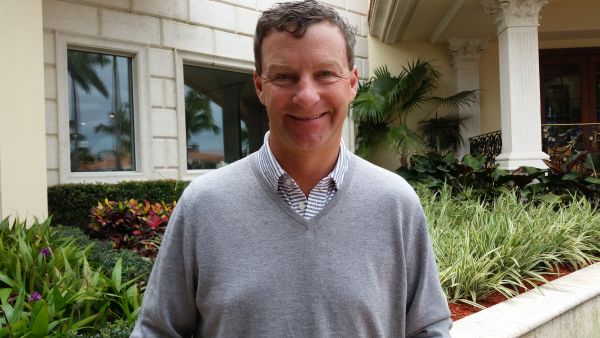
Acclaimed golf course designer Gil Hanse at last week’s WGC – Cadillac Championship. (Photo – www.golfbytourmiss.com)
More recently the Philadelphia-based Hanse oversaw the redesign of Trump International Doral and venue for last week’s WGC – Cadillac Championship while he carried out the work in redesigning TPC Boston and host venue of the FedEx Cup Play-Off Series Deutsche Bank Championship.
Now after some two-and-a-half years after being handed the Rio de Janerio design Hanse has signed off on the often controversial project.
“I am very pleased with the course and it’s been a great opportunity for our design team and while everyone who has been following the story knows the project went on a bit longer than we anticipated so to now have the design complete and turned over for growing is a huge hurdle we’ve negotiated,”said Hanse.
“It’s also very timely because any later and the golf course would not be mature enough for the Olympics.
“So I now feel good about the time frame as it relates to preparations for competition and we feel about what we designed and how it’s all come together so it’s all positive.”
Hanse moved his young family to Rio de Janerio to ensure he could oversee all work in the design in the course and had done the same in the late nineties after being handed the job of designing the second golf course at the Crail Golfing Society in Scotland, and golf’s seventh oldest club.
“Crail was my first design project outside of the U.S., but then I was only over there for six to seven months compared to the time I needed to spend in Brazil,” he said.
“Then I never thought we would be down in Brazil for two-and-a-half years as we thought we could get everything we needed to accomplish in 12 to 13 months.
“Actually it was two-and-a-half years after we were selected rather than two-and-a-half years from construction and that was some 18 to 19 months but that’s still about six to seven months more than we anticipated but then the site was all sand and it was pretty easy to move around.
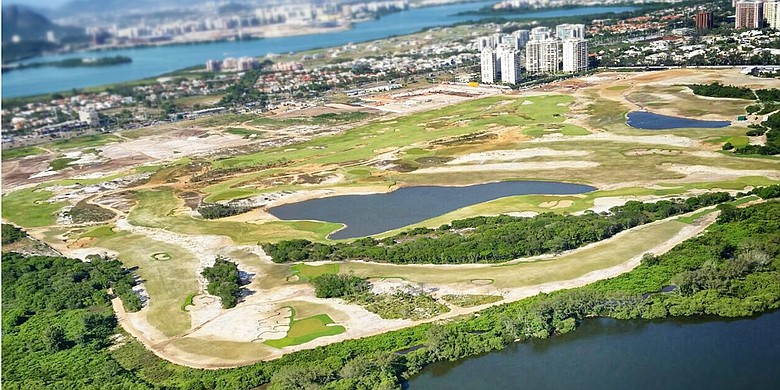
The Rio de Janeiro Olympic Games course.
“And the model we shopped for in Brazil is along the famed Melbourne ‘Sandbelt’ courses because when we did our presentation we thought to ourselves what does a golf course in Brazil look like.
“There was really no definition because when you think of golf courses in Australia you think of the ‘Sandbelt’ courses and when you think of golf courses in Britain you immediately think of the great links courses of the world.
“So the connotation in Brazil was coming up with a bad Florida golf course with palm trees and white sand but that’s all we had to look out but the site, along with the natural qualities of the vegetation and the sand led us to believe is could more like a ‘Sandbelt’ course and that’s what shopped for.
“The golf course will play to a par 71 and we have done that on purpose as there will be a lot of people in Rio for the Olympics who have never seen golf before and there may be developing countries who may want to emulate this golf course for their own country.
“But if it’s going to be 7500 yards playing to a par 72 they are all going to think then that must be the standard so we built a part 71 with four par 5s, five par 3s and the remainder par 4s.”
It has been well-documented the problems Hanse and his team faced in getting the project off the ground including environmental issues while according to reports Eduardo Paes, the major of Rio de Janerio is facing an inquiry into alleged misconduct in the construction process.
And other reports say activists allege developers will earn some $US 350m on a $US 21m investment, and with the activists accusing the city government of gerrymandering the boundaries of the adjoining nature reserve and changing laws that allowed the course’s construction.
“We knew that it would be slow to start with but then we faced all these legal challenges but then the primary reason why we were slowed down was getting the people down there to understand what it takes to build a golf course,” he said.
“But the good thing about this Olympic Games course is that it will be the first truly public golf course in Brazil as all the other courses are private.
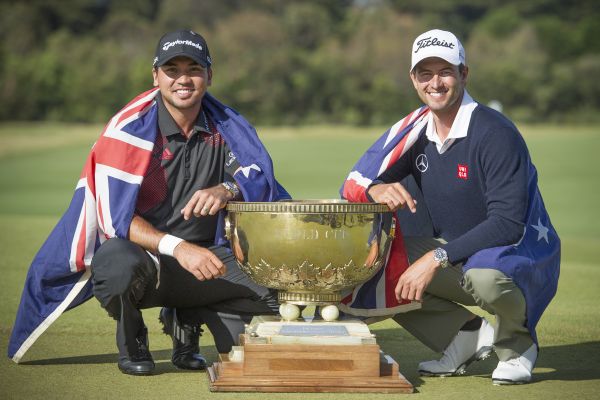
Gil Hanse believes the ‘Sandbelt’ nature of the 2016 Olympics Games course should suit the Australians Adam Scott and Jason Day. (Photo – www.golffile.ie)
“I would be happy to go back to Brazil to again to design another course but it would have to be the right owner and a great site but then that’s just not Brazil as that’s just in travelling outside of the United States I really don’t want to go working on a project that we can’t build something exceptional.”
However Hanse revealed the Olympic Games course is yet to be named and he is unsure if there will ever be an official ribbon-cutting ceremony.
“Any Olympic Games venue whether it be a golf course or whatever has to be approved by the IOC and what they are going to ask for is to have the word ‘Olympic’ in part of the name and that is a negotiation I am not a part of,” he said.
“I will go back in August this year to check on how everything is going and then also just prior to the Games itself while it’s going to be exciting being there when competition finally gets under way.”
And Hanse again expressed his surprise in the format of competition next September and believes the IGF and IOC is missing a golden opportunity to showcase the ancient game.
“I have already stated publicly that I understand why they selected four rounds of medal play but the thing that still mystifies me is why is there no team competition and the Olympics is all about team competition,” he said.
“The Olympics is all about nationalism and representing your country and performing for your country but the fact that this is an individual competition, even though you are still representing your country strikes me as strange.
“In the World Cup of Golf they adopt a format where you may declare yourself as an individual but you tee up as a member of a team.
“It just would have made great sense to have that team element and why they didn’t go for that approach doesn’t make sense.
“So it would have been nice to distinguish this and make it separate but then I understand this is the first time time the IGF wanted to gain the support of the players and not have to play match-play and knocked out after one round.
“Also they did not want to be too experimental.
“But the competitors will face a very open golf course off the tee it will be also important to place the golf ball in the right place off the tee to gain access to the pins.
“So while long hitters like Rory (McIlroy) will like it but it will also suit the shorter hitters as it will be a very different second shot golf course with some interesting contours once on the greens.
“Overall it’s going to suit the player comfortable playing the ball on the ground and should the wind get up, as it will around the time of the Olympics, then it will have links like characteristics.
“And given also its ‘Sandbelt’ like feel I would think the Aussies in Adam Scott and Jason Day should be right at home and comfortable playing the course.”


