At long last, the USGA as organisers of the annual U.S. Open have finally seen some common sense.
The U.S. Open will now fall into line with other three Majors and conduct a play-off straight after regulation play and should two or more players be tied for the lead.
However, it will be a two-hole aggrefate play-off and why is not one half of golf’s ruling body talking with it’s St. Andrews based other half and agree of a four-hole aggregrate play-off?
The USGA reports the change will be effective at the 2018 U.S. Open at Shinnecock Hills on New York’s Long Island.
And the USGA has also decided to run the same two-hole aggregrate play-off for the U.S. Women’s Open, U.S. Senior Open and U.S. Senior Women’s Open.
The U.S Open has had 33 playoffs in its 117 years, all decided by 18 holes or more.
“There was a time when they did make sense before television, before the modern era of wanting everything decided immediately,” said Mike Davis, chief executive of the USGA.
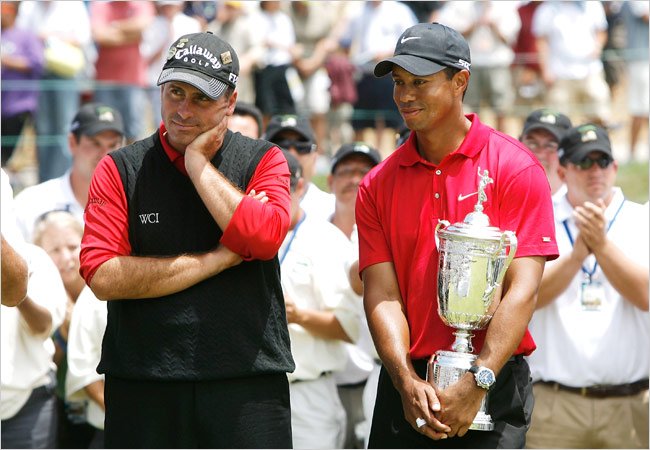
Rocco Mediate and Tiger Woods at 2008 US Open – the last occasion the U.S. Open staged a Monday play-off.
“There is no correct way to determine a tie in stroke play.”
It has been a decade since the last Monday play-off at a U.S. Open and was when Tiger Woods defeated fellow American Rocco Mediate to capture his 14th Major.
The efflort coincided with Woods breaknig through the $100m career earnings barrier and being World No. 1 for a 500th week.
AP reports the Masters was the first major to abandon the 18-hole playoff in 1976 when it changed to sudden death. The PGA Championship did the same a year later, and Lanny Wadkins won the first sudden-death playoff in major championship history in 1977 at Pebble Beach. The PGA later changed to a three-hole aggregate.
The Open, and golf’s oldest Major, changed to a four-hole aggregate in 1986.
Davis said the USGA chose a two-hole playoff to allow a player to recover from one bad shot and still keep the intensity of the playoff being decided quickly.
The 10-year stretch between playoffs is the longest in U.S. Open history.
“This came up about two months ago,” Davis said. “We’ve had 33 playoffs since 1895. Do your math and that’s one every 3 ½ years. For the last 23 years, we’ve had two playoffs. So it was proactive.”
He said the USGA asked players, broadcaster partners, vendors and fans about ending the 18-hole playoff.
“I won’t say it was everybody, but seemingly it was, ‘Why do we have to come back tomorrow?'” Davis said.
No one seemed to mind the last playoff, mainly because it involved Woods, who was playing for the first time since the Masters because of a shattered left leg that required surgery two weeks after he won. There was pandemonium at the gates with people trying to get in, and concession stands had long lines with few vendors. Davis said it was one of the largest digital audiences for a sports event because so many people were at work.
Stewart Cink, who won the British Open at Turnberry in 2009 over Tom Watson, liked the idea of scrapping the 18-hole playoff.
“I think 18 holes is a bit much for a playoff, and it’s more often than not going to be a bit anticlimactic,” he said. “They’ve got the captive audiences, the players are at the peak of their games, why not let them duke it out? They’ve got plenty of daylight. Whether it’s two, three or four holes doesn’t matter. I do not like the sudden-death aspect of the major. I think one hole is a little quick to decide a major.”
The USGA also felt the three-hole aggregate playoffs for the U.S. Women’s Open — instituted after Annika Sorenstam beat Pat Hurst in 18 holes at Newport Country Club in 2006 — and the U.S. Senior Open worked well.
Davis also said he was having a hard time explaining why the men had to go 18 holes for a playoff and the women played only three holes.
“That got us to say, ‘Let’s look at every aspect.’ We just concluded now is the right time,” Davis said.
Davis said the two-hole aggregate would be different holes, but not limited to the 17th and 18th holes depending on the course.
In the case of Shinnecock Hills, playing the 17th and 18th would mean a par 3 and a par 4. The 17th and 18th holes at Pebble Beach in 2019 would be a par 3 and a par 5, two of the most scenic holes in American golf.
- Thanks to AP for this story


