Tiger Woods added another ‘rules incident’ chapter to his golfing career last week in Charolette that once again has drawn debate if the ruling was in the ‘spirit’ of the game.
Woods hit an errant approach shot into the fifth hole during the second round of the Wells Fargo Championship at Quail Hollow.
Spectators rushed to the location that PGA rules officials said was ‘basically bare ground’ but no golf ball was found.
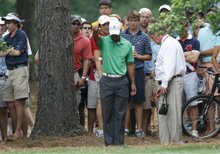
Tiger Woods being afforded a controversial free drop during the second round of last week's Wells Fargo Championship.
The official quizzed spectators before ruling an ‘outside agency’ was responsible for Woods’ ball being lost and based on that information then advised Woods he could have a ‘free’ drop.
The incident quickly rekindled memories of three other controversial rules incidents in Woods career.
Tiger and the boulder – 1999 Phoenix Open.
Woods was competing in the final round of the 1999 Phoenix Open when his drive at the 13th hole came to rest beside a large boulder.
Under the Rules of Golf, any loose impediment may be removed except if the ball lies in a hazard.
Loose impediment is defined as natural objects, such as stones, leaves, twigs, branches, worms and animal droppings.
However when a dozen spectators were needed to shove a large boulder out of the way so Woods could attempt to hit the green at the par-5, 585-yard hole the question as the whether removing the boulder was within the ‘spirit’ of the rules.
In fairness, the boulder was not solidly embedded but can spectators, caddies, fellow competitors or anyone else assist a player in removing a large loose impediment.
Under Decision 23-1/3 the answer is: ‘Yes’.
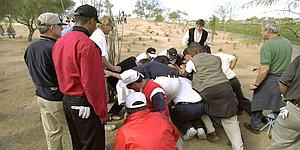
- A dozen spectators move a boulder as Tiger Woods looks on.
Woods went on to make a birdie but finish three shots behind Rocco Mediate.
There was immediate cries of unfair and suggestions had Woods been a lesser known player would he have been allowed to move the boulder.
Tiger and the cook – 2006 WGC Bridgestone Invitational.
When is a clubhouse out-of-bounds? Very much in every case when you play golf.
But during the second round of the 2006 WGC – Bridgestone Invitational Woods hit an approach 9-iron shot into the ninth green and the final hole of his round on the Firestone course that cannoned off the cart path and onto the roof of the clubhouse before landing in a loading dock
A cook, who was delivering pies at the time, saw Woods’ ball bounce near his cart and thinking someone had thrown it in his direction, picked it up and drove off with it.
He put the ball in the drinks holder of the cart and thought no more of it. It’s believed a security officer then pocketed the ball.
However the time Woods saw his ball sail over the grandstand it took 32 minutes with PGA Tour rules officials then acting under the ‘temporary immovable obstruction’ rule to afford Woods a ‘free’ drop.
Woods, who was playing in the company of Ireland’s Paul McGinley, then played a stunning chip onto to miss his par putt.
Woods then went onto to defeat Stewart Cink in a play-off in near darkness for his fifth success in the event.
Had the clubhouse been out-of-bounds, as it is at the great majority of golf courses, Woods would have incurred a one-stroke penalty and had to replay the shot and probably ended with a double bogey and eventually lose the tournament by a stroke.
Tiger and the TV cables – 2007 Open Championship.
In playing the par four 10th hole at Carnoustie during the 2007 Open Championship, Woods pulled his tee shot into rough and with his ball coming to rest on top of a line of TV cables.
However before Woods could even get near his ball, R & A Rules official, Alan Holmes, and now Chief Referee, walked up to Woods stating he could take a free drop from the cables given the American would struggle moving them.
Holmes indicated the cables were fixed.
So Woods got to drop his ball one club length away in trampled grass that immediately drew debate as to why he should not have marked his ball, moved the cables and then taken a drop.
Mark Roe, working then for BBC Five Live radio, later went to the spot and had no trouble lifting the cables and moving them some three feet.
Woods went on to hole an eight foot putt to save par in an eventual round of a two under par 69 before Ireland’s Padraig Harrington captured his first of three Major championship titles.
Roe later approached Holmes saying he gave a wrong ruling but the R & A denied he had.
‘Golden Bear’ Jack Nicklaus competed on the PGA Tour and in Majors for 25 years before actually losing a golf ball and that was on the 10th hole during the 1986 U.S. Open at Shinnecock Hills.
And Arnold Palmer, after driving behind a small wooden bridge, called on marshals and spectators to move the offending bridge that had been erected to span a creed at the 1965 PGA Championship at Laurel Valley and close to Palmer’s hometown of Latrobe in Pennsylvania.
Palmer deemed the wooden bridge ‘an artificial object’.
Rules officials deemed it a breach of the rules and slapped Palmer with a two-stroke penalty.


